
Java Interview Question - Why Collection doesn’t extend Cloneable and Serializable interfaces ?
Answering Popular Java Interview Question

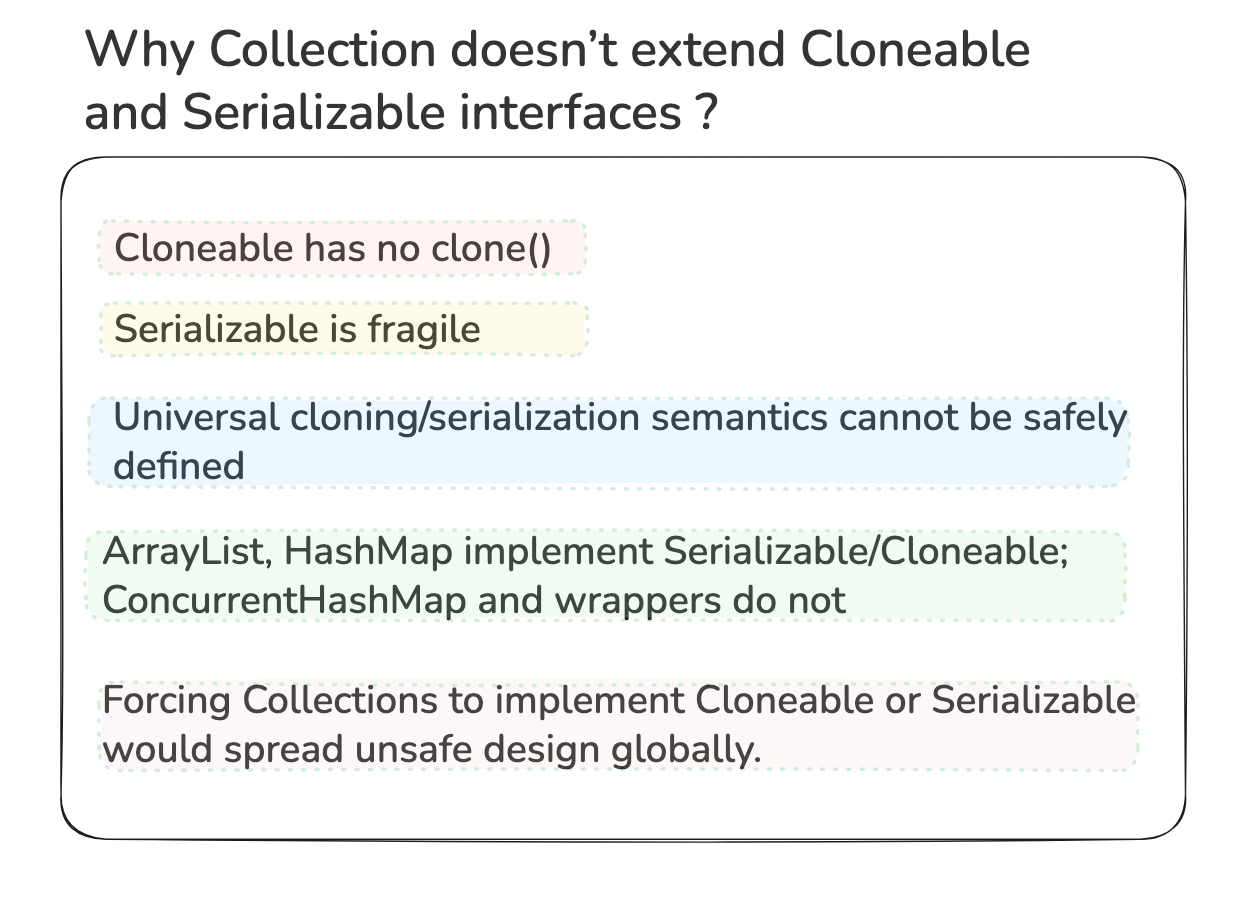
Java intentionally avoided making Collection extend Cloneable and Serializable for design-cleanliness, flexibility, and backward compatibility.
🚀 Unlock Your Path to Success with the Ultimate Everything Bundle! 🚀
Introducing the Everything Bundle — your one-stop solution to mastering Java, Spring Boot, SQL, acing interviews, and securing certifications!
Not All Collections Can or Should Be Cloned
Some collection implementations cannot be meaningfully cloned.
Others rely on external resources, shared mutable state, or complex internal nodes.
Example:
Collections.unmodifiableList(...): What does cloning unmodifiable data mean? Deep copy underlying list? That violates view semantics. The clone is no longer a view.
Not All Collections Should Be Serializable
Making Collection extend Serializable means:
Every collection must support serialization.
Many collections wrap non-serializable data or hold items that aren’t serializable.
Examples:
WeakHashMapuses weak references → not serializable in many cases.TreeMapwith a non-serializableComparator→ cannot serialize.ConcurrentSkipListMap→ serializing lock/state is tricky.
Allowing Collection for extension Serializable would force every implementation in the world—existing and future—to comply. That creates:
Unreasonable constraints
Backward incompatibility
Broken abstractions
Instead:
Collection implementations that can be serialized choose to do so.
This keeps the interface simple.
Cloneable and Serializable Are Marker Interfaces — Not Good for APIs
Both interfaces are considered design mistakes today because they don’t define behavior.
Cloneable is broken:
Doesn’t declare
clone().Requires ugly
protected Object clone()override gymnastics.Encourages shallow copying bugs.
Serializable is fragile:
Serialization is a global mutable format.
Can break across versions.
Has security pitfalls.
Because of these flaws, the Collections API designers avoided making them mandatory.
We Should Not Depend on clone() for Collections Anyway
Preferred alternatives:
To copy:
new ArrayList<>(existingList)List.copyOf(list)List.of(...)
To serialize:
Use JSON, protobuf, CBOR, or custom serializers — NOT Java serialization.
Historical Reason: The Collections Framework Was Added in Java 1.2
When Java 1.2 added the modern Collections Framework:
There were already many pre-existing classes (
Vector,Hashtable) that did implement both.New classes (
ArrayList,HashMap) also implementedCloneableandSerializablevoluntarily.
But the designers did not want:
to break backward compatibility,
to force future implementations to comply.
So they kept the base Collection interface clean.
TL;DR
Because not all collections can or should be cloned or serialized.
Forcing Cloneable and Serializable on the Collection an interface would impose incorrect, unsafe, or impossible constraints on many implementations. Java designers also consider both interfaces flawed (marker interfaces with improper semantics), so they allow individual collection classes to implement them only when appropriate.