
Spring Boot Interview Question - Kafka Consumer Became a Zombie
The Consumer Was Alive. The Business Was Not.

Scenario
You’re on-call for a Spring Boot service called TransactionIndexerService.
The service consumes transaction events from Kafka and indexes them into Elasticsearch.
The service runs in Kubernetes and uses Spring Kafka.
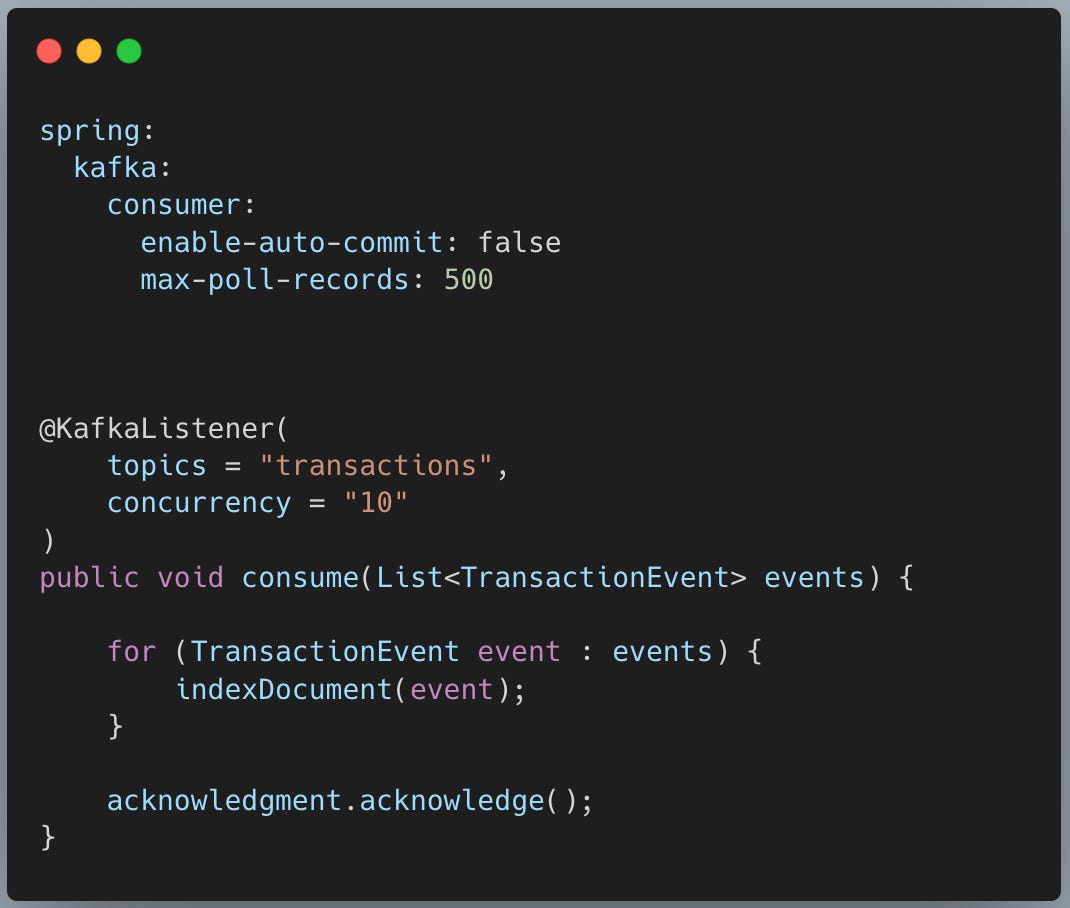
The application has been stable for months.
Incident
At 2:17 AM:
Consumer Lag: 0 → 8 MillionYou open Grafana:
CPU Usage      : 3%
Memory Usage   : Stable
Pod Restarts   : 0
Error Rate     : Low
Consumer Lag   : Growing rapidly
The service appears healthy.
You find logs:
02:17:03 ERROR

org.apache.kafka.common.errors.TimeoutException:
Timeout of 60000ms expired before successfully committing offsets
A few minutes later the infrastructure team reports:
AWS MSK performed a maintenance operation.

During maintenance the consumer group coordinator became unavailable for approximately 2 minutes.
📢 Get actionable Java and Spring Boot insights every week, including practical code tips and real-world, use-case-based interview questions, to help you level up your backend skills—join 7500+ subscribers for hand-crafted, no-fluff content.
First 100 paid subscribers will get the annual membership at $50/year forever that is ~ $4/mo ( 92 already converted to paid, 11 remaining)

Testimonials

Question 1
The application never crashed. Pods remained healthy. However:
records-consumed-rate = 0for more than 30 minutes.
How is this possible?
Explain what might have happened inside:
Spring Kafka
Kafka consumer group
Offset commit mechanism
Reasoning
The pod was healthy, but the Kafka consumer was not.
From the logs shared by infrastructure team, during the MSK maintenance, the consumer group coordinator became unavailable. Since offset commits are sent to the coordinator, commit operations started timing out.
A likely sequence is:

Coordinator unavailable
↓
Offset commits fail/timeout
↓
Consumer stops polling regularly
↓
Heartbeats stop
↓
Consumer removed from group
↓
Partitions revoked
↓
No records consumed
Even after the coordinator recovered, the consumer may not have successfully rejoined the group or resumed polling, leaving the application in a "zombie" state.
From Spring Kafka’s perspective:
Listener container alive
JVM alive
Pod alive
but:
No partition assignments
No successful polls
No message processing
so records-consumed-rate remains zero.
The key lesson is that process health != consumer health. Kubernetes only sees a running Spring Boot application, while the Kafka consumer group has stopped making progress.
Under what conditions do Spring Kafka will recover automatically?
Spring Kafka will recover automatically only when the underlying consumer loop keeps functioning and Kafka can re-establish group coordination on its own.
Poll loop is continuously running
Spring Kafka recovery depends on this core rule:
poll() must keep being calledAs long as:
listener returns quickly
no blocking in user code
container thread is alive
then Kafka client can:
send heartbeats
refresh metadata
retry coordinator lookup
rejoin group
Temporary coordinator or broker failure
If failure is short-lived:
Coordinator down (MSK maintenance)
↓
commit/poll fails temporarily
↓
Kafka client retries internally
↓
Coordinator comes back
↓
Consumer resumes
No app restart needed.
3. Heartbeats are not interrupted
Recovery works only if:
heartbeat.interval.ms keeps firingThat happens only when:
poll is happening regularly
thread is not blocked
Then Kafka can detect:
group instability → trigger rebalance → recover4. Consumer stays in a valid group state
If consumer is only temporarily disconnected:
still has valid session
not fully evicted from group
Then it can rejoin automatically when coordinator returns.
5. Rebalance completes successfully
Spring Kafka recovers when:
rebalance → partitions reassigned → listener resumesThis is fully automatic if the container is healthy.
When Spring Kafka will not recover automatically ?
1. Blocked poll thread (most common production issue)
Example:
commitSync(); // blocksThen:
poll() stops
↓
heartbeat stops
↓
consumer removed from group
↓
no recovery path
2. Session timeout exceeded
If no heartbeat happens within:
session.timeout.msKafka forcibly removes consumer.
Recovery becomes unreliable because:
consumer must fully rejoin group
may get stuck if thread is blocked
3. Listener thread stuck in long processing
If business logic blocks:
process() takes too longthen:
poll not called
heartbeat stops
consumer dies in group
4. Silent exception swallowing + no poll loop recovery
If:
catch (Exception e) {
    log.warn(e);
}
but loop doesn’t recover state:
consumer remains in broken state
never reinitializes metadata
Explain the difference between commitSync vs commitAsync, which one to use and when?
commitSync()
Sends offset commit request
Blocks until Kafka acknowledges it
Flow:
process records
↓
commitSync()
↓
wait for coordinator ACK
↓
success or exception
Characteristics:
Strong guarantee (commit is confirmed before moving on)
Higher latency
Can block consumer thread
Risk:
If Kafka coordinator is slow/unavailable:
commitSync() blocks
↓
poll() stops
↓
heartbeats stop
↓
consumer can die / lag increases
commitAsync()
Sends commit request
Does not wait for response
Flow:
process records
↓
commitAsync()
↓
continue processing immediately
Characteristics:
High throughput
Non-blocking
Better for hot loops
Risk:
Commit failures may be missed
No strong guarantee unless handled carefully
Example issue:
commit 100 fails
commit 200 succeeds
→ offset 100 retry later can cause inconsistency
Production best practice
Most real systems use both together:
while (running) {
    process(records);

    consumer.commitAsync(); // fast path
}

// on shutdown
consumer.commitSync(); // safe final commit
But important point to note here is when crash or forced termination happens
like:
OOM kill
SIGKILL
node crash
network partition
Then:
NO shutdown hook
NO commitSync
NO final flush
hybrid pattern gives no guarantee here.
Thats all for this week friends! Thanks for reading this far. If you liked it please share with your network.
Happy Coding 🚀
Suraj
Subscribe | Sponsor us | LinkedIn | Twitter
The problem was not your service crash — it was Kafka coordinator downtime during MSK maintenance, which blocked offset commits and caused lag to explode...
Restart the consumer after MSK maintenance and reduce max-poll-records / increase default.api.timeout.ms so offset commits don’t time out again.