
Virtual Threads Make Blocking Cheap (But Not Free)
Explanation, Code Examples and more.

Introduction
For years in Java backend development, blocking meant wasted threads, exhausted pools, and collapsed systems under load. With Project Loom (Java 21), that assumption is no longer true - but only if we understand what actually changed.
In this article, we will discuss why blocking was expensive, how virtual threads changed the cost model, and where blocking is still dangerous with code examples.
Why Blocking Was Expensive Before Loom
In the traditional Java model,
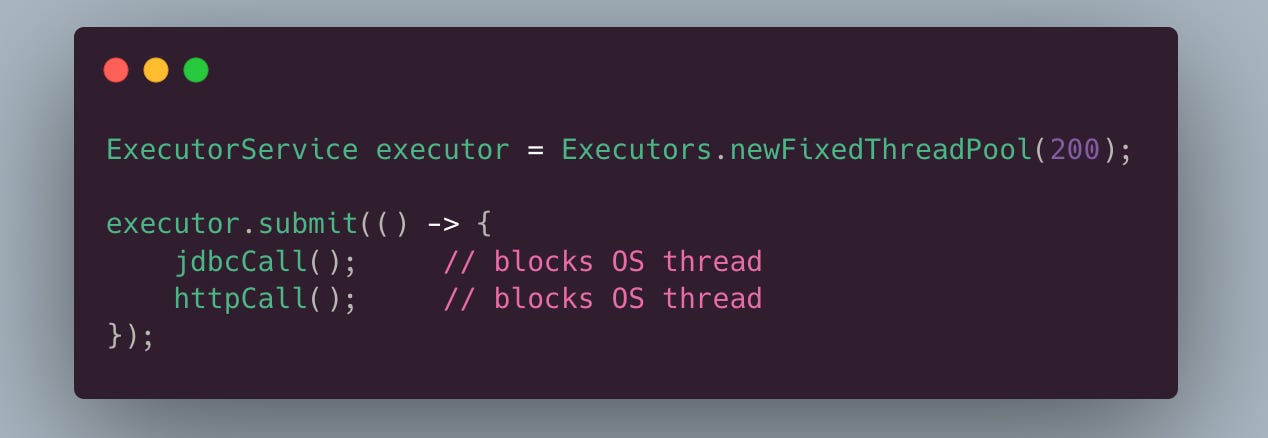
Each request occupies:
One OS thread
A large, fixed stack (~1–2MB)
Kernel scheduling resources
If the thread blocks on I/O:
The OS thread is idle
No other work can use it
Throughput collapses under high concurrency
This forced developers to:
Limit thread counts
Avoid blocking
Embrace async callbacks or reactive frameworks
📢 Consider becoming a paid subscriber for as low as $2.5/mo (with an annual subscription) and support the work :)

Not convinced? Check out the details of the past work
Virtual Threads: What Actually Changed
