
Engineering With Java: Digest #86
From Pet Adoption to Production: Spring Boot Gets Serious (But Not Too Serious)

👋 Java Devs! Welcome to this week’s addition! I hope you’re all doing great.
This week we reached important milestone. Engineering With Java newsletter is now at 7000+ subscribers with 84 of you decided to upgrade to paid. Thank you ❤️

This week, we cover essential insights on:

📢 Get actionable Java and Spring Boot insights every week, including practical code tips and real-world, use-case-based interview questions, to help you level up your backend skills—join 7000+ subscribers for hand-crafted, no-fluff content.
First 100 paid subscribers will get the annual membership at $50/year forever that is ~ $4/mo ( 84 already converted to paid, 16 remaining)

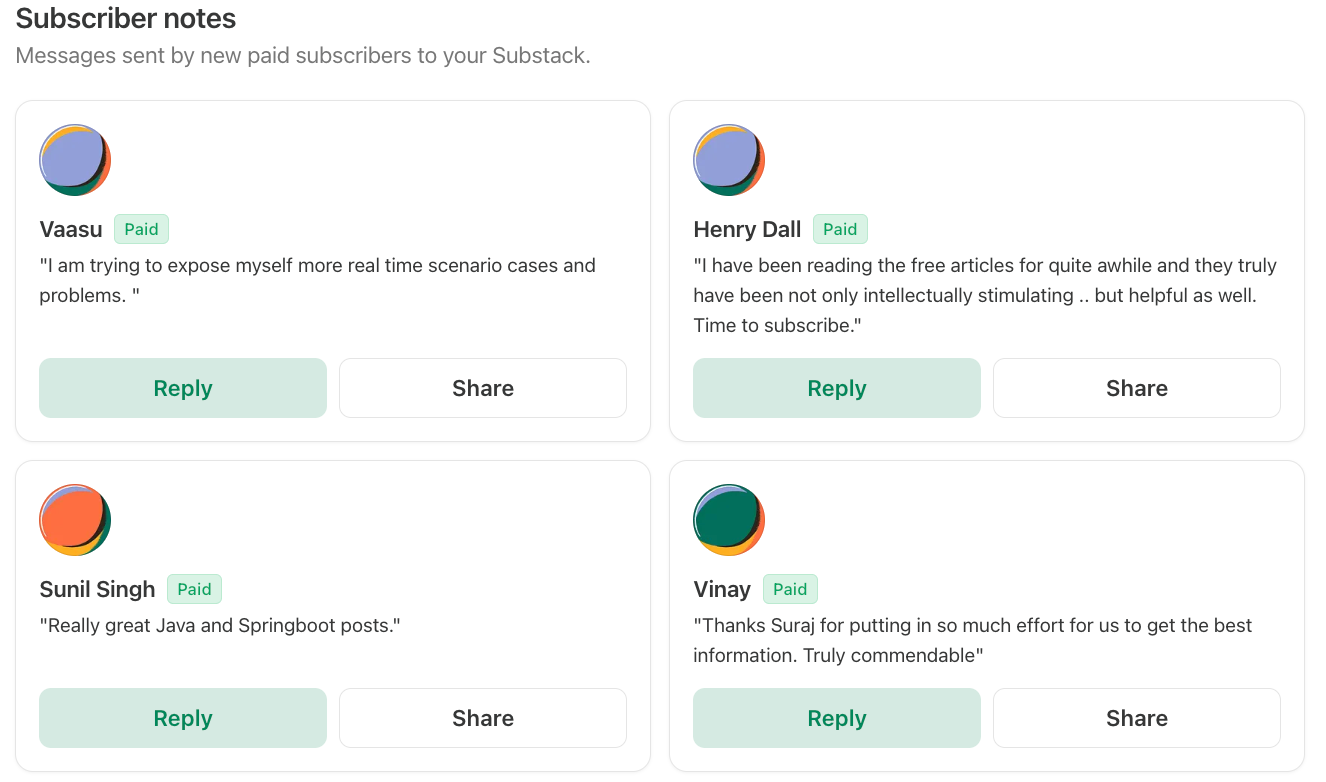
Testimonials

JobRunr Introduces ClawRunr, an Open-Source Java AI Agent : ClawRunr is an open-source Java AI agent runtime built with Spring Boot, Spring AI, and JobRunr that runs locally and treats agents like production workloads, with scheduling, retries, persistence, monitoring, and tool integrations built in. The key takeaway is that Java’s orchestration and reliability strengths make it well-suited for long-running autonomous AI agents.
AI APIs Are Slow — Here’s How We Made Them 5x Faster in Spring Boot: This article shows how parallel calls, caching, async processing, and streaming responses in Spring Boot can make AI APIs significantly faster. The key takeaway is that AI latency is often an architecture problem, not a model problem.
Java in a Container: Efficient Development and Deployment With Docker:
This article explains that Java in Docker needs container-aware JVM tuning, especially for CPU and memory limits. The key takeaway is that proper JVM settings prevent wasted resources and unexpected crashes in containers.
Request Coalescing in Spring Boot for Hot Cache Keys : This article explains request coalescing, when many requests miss the same cache key, only one fetches the data while others wait, preventing cache stampedes and reducing backend load.
Large-Scale ETL Pipeline Architecture : This article explains that scalable ETL pipelines need more than data transformation—they need concurrency control, backpressure, and fault recovery to run reliably at scale.
Dockerizing a Java 26 Project with Docker Init : This article shows how Docker Init can auto-generate a production-ready setup for a Java 26 app, using multi-stage builds and optimized images. The key takeaway is that modern tooling makes Java containerization fast and standardized by default.
Deep Dive into Kafka Offset Commit with Spring Boot : This article provides a deep dive into how Kafka offset commits work in Spring Boot consumers, showing how different configurations (single-threaded, concurrent consumers, async processing, and graceful shutdown behavior) can lead to message duplication or message loss. It emphasizes that correct offset management requires aligning processing strategy with commit timing, especially when using concurrency or async execution.
From an article to a library: hybrid caching for Spring Boot, completed : This article explains how to turn a hybrid caching approach (local + distributed cache in Spring Boot) into a reusable library, focusing on production concerns like cache invalidation, consistency, and performance tuning across multiple nodes.
Optimizing Recommendation Systems with JDK’s Vector API : This article shows how Netflix uses the JDK Vector API to speed up recommendation calculations by accelerating vector math (like similarity scoring). The key takeaway is that Java can now handle high-performance ML workloads directly in the JVM using SIMD optimizations.

Make Java Safer with Flexible Constructor Bodies : Flexible constructor bodies (Java 25, JEP 513) allow safe logic and validation before calling super(), fixing issues where parent constructors can observe partially initialized child state or violate subclass constraints. This improves constructor safety, avoids awkward validation patterns, and makes object initialization more predictable in deep inheritance hierarchies.
Modernizing Java UIs Without JavaScript: Escape the Multi-Stack Trap : This talk introduces WebSwing to run existing desktop apps in the browser and Web for J to gradually build modern web UIs in Java, enabling a step-by-step migration while reusing existing business logic and avoiding full rewrites, multi-stack complexity, and high migration risk.
Bootiful Spring Boot 4 by Josh Long : Josh Long humorously walks through building and modernizing a Spring Boot application (Java 25, Spring 7/Boot 4 concepts), covering dependency injection, API versioning, declarative HTTP clients, and resilience patterns like retries and rate limiting. He emphasizes practical Spring improvements that reduce boilerplate, improve modularity, and make distributed systems more robust while building a playful “pet adoption” backend example end-to-end.

Spring Boot Interview Question: Debugging Hidden Side Effects in Stream Pipeline
Java Interview Question: Detecting the First Non-Retryable Event in a Stream
Thats all for this week friends! Thanks for reading this far. If you liked it please share with your network.
Happy Coding 🚀
Suraj
Subscribe | Sponsor us | LinkedIn | Twitter